Tenex Health Procedures
Tenex Health's minimally invasive technology eliminates chronic tendon pain by precisely targeting and removing damaged tissue, without the need for major surgery.

Developed in collaboration with the world-renown MAYO Clinic, Tenex Health technology has been shown to improve overall functionality and significantly decrease pain in the treatment of tendonitis in the elbow, hip, knee, ankle, and plantar fasciitis pain in the foot.
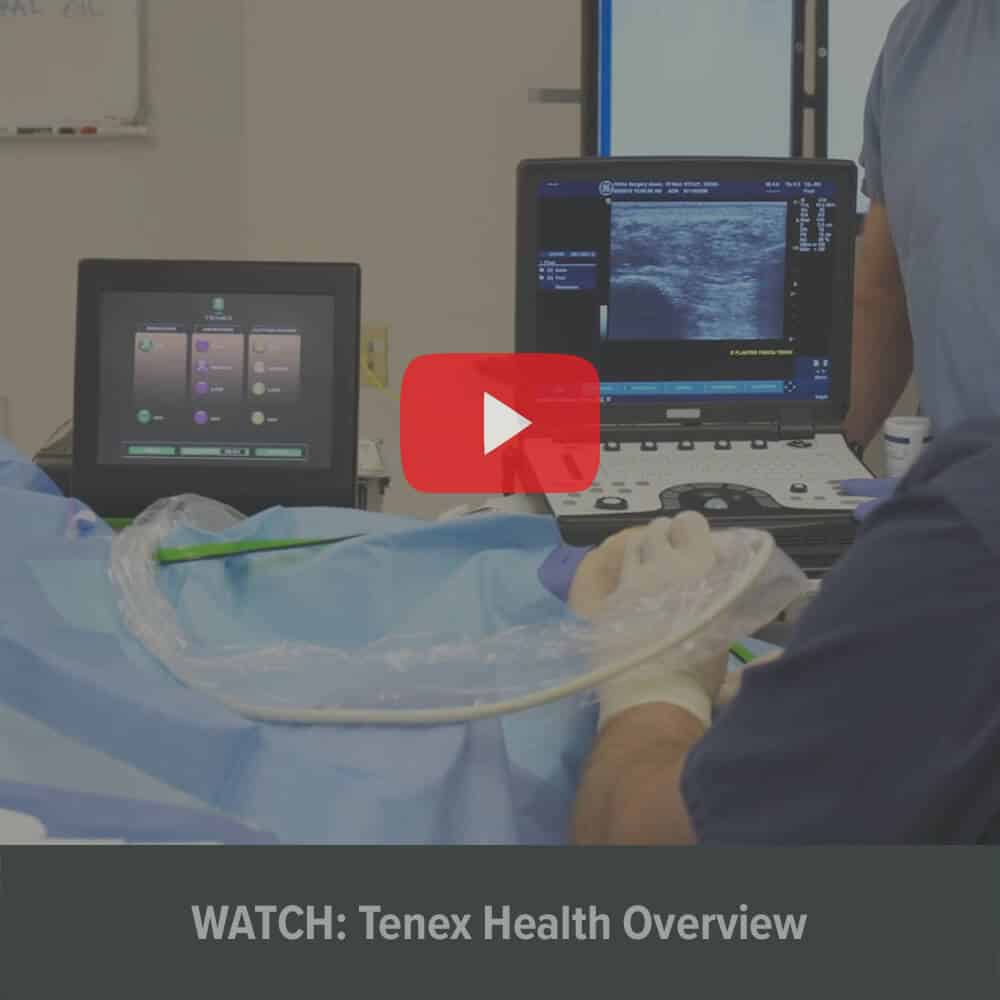

What To Expect
- Your doctor will use ultrasound imaging (the same non-invasive technology used to see babies in the womb) to visualize and identify the specific location of the damaged tendon.
- Your doctor will then numb the area with a local anesthetic, gently applying Tenex Health’s ultrasonic tool to safely breakdown and remove the damaged tissue.
- As the required incision is minimally-invasive and the ultrasonic energy precisely treats only the damaged tendon tissue, the surrounding healthy tissue is left unharmed.
- Stitches are not required, so your doctor will only apply a small, adhesive bandage after the procedure.
- You will be able to go home immediately after the procedure is completed.
The Tenex Health TX MicroTip at a glance
- FDA cleared. More than 90,000 patients treated.
- Clinically proven effective in greater than 85% of patients.
- No stitches required. Walk out with just an adhesive bandage .
- Does not disturb surrounding healthy tissue.
- One time treatment with a quicker recovery than surgery.
- Treats tendon pain at its source.
How does it work?
- First, your doctor uses ultrasound imaging to identify the location of your damaged tissue.
- Next, your doctor makes a tiny incision, approximately 1/4 inch long, and inserts a TX MicroTip (shaped similarly to a syringe) to gently apply ultrasonic energy to break down and remove damaged tendon tissue, while leaving your healthy tissue unharmed. This has been shown to stimulate a healing response in your body.
- Once the procedure is complete, your doctor applies a small adhesive bandage to the area. Often the patient can drive home immediately afterwards because typically only local anesthesia is required.</.p>
- Patients experience rapid relief and recovery and typically return to normal activity in 6 to 8 weeks.
Clinical studies have shown that patient recovery times are 6-8 weeks when Tenex Health technology is used1,5 for treating chronic tendon pain, compared to the 7-8 months for recovery after conventional surgery10.
Frequently asked questions
This technology is FDA-cleared with over 90,000 procedures completed in the United States since 2012.
Clinical studies have been conducted showing more than 85% of patients are pain-free within weeks of treatment and more than 99.9% of procedures are completed without complications.
After the procedure, patients may experience the following effects which often return to normal in a few days:
- Redness of the skin where the incision was made
- Swelling at the incision
- Soreness in the treated area
Ultrasonic Percutaneous Tenotomy is safer than open surgery.
Only a doctor can decide if you are a candidate for treatment. However, here are some common indicators:
You can point to a specific place in your heel or foot where your pain is located You have suffered plantar fascia or tendon pain for over 3 months Resting has not improved your pain
Physicians who can perform the procedure include orthopedic surgeons, podiatrists, sports medicine trained fellowship doctors, interventional radiologists, interventional pain doctors, and PM&R physicians.