Bone Marrow Aspirate Concentrate: A Non-Surgical Solution

Bone marrow aspirate concentrate, or BMAC, is taken from a person's own marrow. Regenexx® image-guided injections place this concentrate into the injured tissue to help repair tendons, ligaments, cartilage, spinal discs, and bone. The protocol addresses joint injuries and degenerative diseases, including osteoarthritis and avascular necrosis.

Because the procedure is minimally invasive, many people choose it instead of elective orthopedic surgery or joint replacement. It aims to ease pain and restore movement without the prolonged downtime and rehabilitation that typically follow surgery.

Floridians can receive these research-based treatments at New Regeneration Orthopedics, the state's only Regenexx network provider.

Advancements In Our Regenerative Orthopedic Procedures

Regenexx protocols continue to improve through ongoing research. The newest process captures more cells and shows better clinical results than earlier methods.

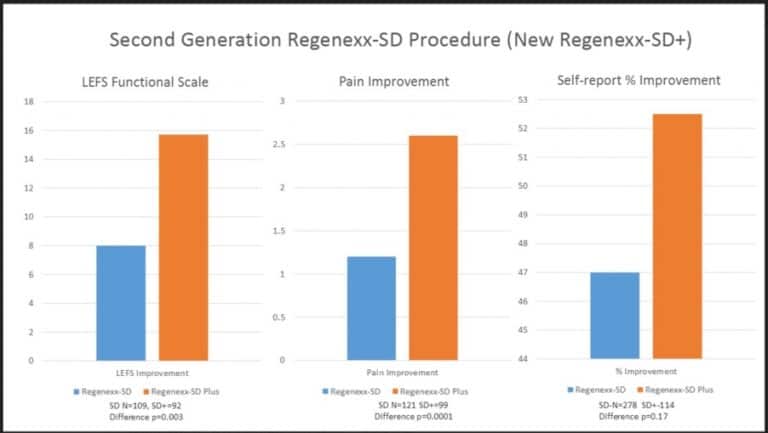
As shown in the chart below, a large patient group achieved significant improvements on the Lower Extremity Functional Scale, or LEFS, and lower pain scores. These numbers are based on data from a five-month follow-up. The updated process increases cell counts and yields stronger functional outcomes than previous versions.

Clinical data for knee arthritis patients from before and after making the switch to the newest generation of our patented same-day Regenexx procedure.

All network providers now use this second-generation, same-day BMAC technique known as Regenexx-SD. A third-generation version is under development.

Innovation also extends to platelet therapies. Regenexx utilizes a third-generation platelet lysate rich in growth factors, and a fourth-generation product is currently under study. Platelet-rich plasma, or PRP, has advanced to a second-generation mix named Super Concentrated Platelets, with further refinements planned.

These advances confirm Regenexx’s goal of providing less-invasive orthopedic care that reduces pain and restores movement through research-based protocols rarely found in standard clinics.

Regenexx® Technology For Regenerative Orthopedic Care

Regenexx invests heavily in research that is guided by PhD scientists, physicians, and biostatisticians. The program focuses on refining each step of the procedure to improve patient outcomes.

Several years ago, the team began developing a new method for processing bone marrow, with one clear goal: to recover more stem cells during aspiration. The latest protocol raises stem-cell yield by more than 500 percent compared with earlier versions.

Even before this update, Regenexx isolated roughly three to four times more stem cells per cubic centimeter than standard automated centrifuge systems. Those systems follow a uniform protocol. In contrast, the Regenexx process is tailored to the unique cellular makeup of each individual’s marrow.

After extensive testing, the research group selected a technique that consistently improves cell recovery. Higher counts matter, yet the primary aim remains the same: stronger clinical results.

Recent data from individuals with knee osteoarthritis show greater pain relief and improved joint function after undergoing the latest same-day Regenexx-SD procedure. These findings underscore the importance of ongoing innovation in supporting less-invasive orthopedic care.

What Is Regenexx®-SD Bone Marrow Concentrate, And How Does It Work?

Regenexx-SD is a same-day procedure that concentrates bone marrow aspirate. The resulting solution contains stem cells and related progenitor cells, which naturally aid in tissue repair after injury. Age or extensive damage can limit the body’s ability to send enough of these cells to the injured area.

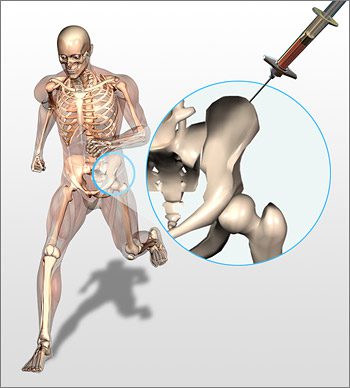
During the procedure, clinicians draw marrow from the back of the hip—a region rich in regenerative cells. Laboratory processing then concentrates the healing components.

Guided by real-time imaging, a physician injects the concentrate into the injured joint, tendon, ligament, or other tissue. Precise placement supports the body’s own repair response and is designed to alleviate pain while enhancing function.

Regenexx-SD fits a range of orthopedic conditions. A comprehensive evaluation, including imaging review and clinical assessment, determines whether bone marrow concentrate or a platelet-based option best matches the injury’s location and severity.

What To Expect

Regenexx-SD involves a series of precisely timed injections spread over several days. Each step draws on BMAC and proprietary platelet preparations to reinforce the body’s own repair response. The exact schedule may vary depending on the condition being treated and the individual’s response.

Before The Procedure

A pre-injection visit comes first. Clinicians inject a small amount of hypertonic dextrose into the injured area. This triggers mild inflammation that jump-starts healing and prepares the tissue for the upcoming BMAC injection. This appointment lasts about 30–40 minutes.

Allergies, medications, and complete health history are reviewed in advance. Individuals treated for spinal conditions may also receive antibiotics and an epidural dose of platelets. This is done to help reduce the risk of infection and support recovery.

During The Procedure

During the Regenexx-SD procedure, patients lie face down. The physician numbs both sides of the posterior iliac crest and uses live imaging to guide the needle. Drawing marrow from both hip bones takes about 30–60 minutes and is only mildly uncomfortable. An oral sedative may be given to ease anxiety and relax muscles.

Technicians then concentrate the marrow into a cell-rich solution. Processing lasts three to eight hours, during which patients rest and eat. 

Later that day, the physician numbs the treatment site again and injects the concentrate into the injured tissue. This reinjection takes about 60–80 minutes. Afterward, patients stay for observation for 30–60 minutes. In total, the clinic visit lasts roughly five to eleven hours.

Because mild sedation or post-procedure discomfort can limit mobility, arranging a ride home is recommended.

After The Procedure

Mild soreness at the injection site is common for one to three days. This discomfort reflects the small needle injury and signals the beginning of the healing process. Acetaminophen can ease pain, but non-steroidal anti-inflammatory medications, or NSAIDs, should be avoided unless a physician says otherwise.

Several days later, most patients receive a follow-up dose of Regenexx Super Concentrated Platelets, prepared from their own blood. The solution adds growth factors that guide tissue repair. In some cases, Regenexx Platelet Lysate supplies an immediate-release boost, depending on the area treated.

Activity is limited for the first 24 hours, then light movement resumes. Braces or other supports may be advised. Individuals can usually return to routine tasks within five to seven days. Vigorous exercise can be resumed after six to eight weeks, depending on individual progress.

Benefits tend to build over several months. Many people report peak gains between six and twenty-four months. However, results vary based on the condition treated, overall health, and adherence to post-procedure guidance.

Who Should Consider The Procedure

The Regenexx-SD BMAC procedure may be an option for joint, tendon, ligament, or spine problems caused by injury or degeneration. It is considered when exercise, physical therapy, or medication has provided only limited relief.

Individuals who may benefit from an evaluation include:

People Suffering From Osteoarthritis

Osteoarthritis is a degenerative joint condition that slowly wears away cartilage. It may cause pain, stiffness, and limited mobility, often in the knees, hips, hands, and shoulders.

Early-to-moderate osteoarthritis that persists despite physical therapy, bracing, or activity modifications may be eligible for Regenexx-SD. The protocol aims to enhance the body’s natural repair of joint tissue, alleviating discomfort and improving daily function.

Evaluation is helpful when symptoms persist despite not being a candidate for joint-replacement surgery.

Patients With Chronic Tendon Injuries

Tendons connect muscles to bones and play a crucial role in movement and joint stability. Overuse, repetitive stress, or inadequate healing can lead to chronic tendon injuries, often resulting in ongoing discomfort, reduced strength, or limited function.

Regenexx-SD BMAC may be considered for persistent tendon problems such as patellar tendinopathy, Achilles tendinopathy, or tennis elbow. It becomes an option when rest, physical therapy, or corticosteroid injections have not provided lasting improvement.

The procedure is designed to support the body’s natural repair mechanisms by delivering concentrated healing cells directly to the affected tendon under imaging guidance.

Those Who Prefer Less Invasive Solutions

Many people seek alternatives to orthopedic surgery due to lengthy recovery times, potential complications, or the use of artificial joint hardware.

For joint, tendon, ligament, or spine problems, Regenexx-SD offers a research-based option that is less invasive than surgery. The procedure is done in an outpatient setting with local anesthesia. Clinicians use live imaging to guide concentrated bone marrow cells into the injured tissue. Recovery is brief compared with surgery.

Typical candidates are not yet ready for an operation and prefer to try a regenerative approach before opting for a more invasive treatment.

Patients Who Are Athletes 

Athletes often injure joints, tendons, or ligaments through impact or repeated motion. Some injuries linger even after rest and standard therapy, cutting performance and extending downtime.

Regenexx-SD offers a less invasive option. Clinicians draw bone marrow, concentrate the repair cells, and place them into the injured tissue with live imaging. The goal is to accelerate tissue repair and improve joint function without surgery.

An evaluation may help athletes with partial ligament tears, tendon pain, or cartilage wear decide if this approach fits their recovery plan.

Why Choose Regenexx®?

Regenexx procedures offer a less invasive path to orthopedic care. They combine precise image guidance, advanced biologic preparations, and treatment plans tailored to each patient. For people who want an option other than major surgery, this approach promotes healing with shorter downtime and less discomfort. It also carries fewer procedural risks.

The Best Possible Patient Outcomes
At Regenexx® no corners are cut. Our regenerative procedures are 100% focused on producing the best possible patient outcomes, without trying to balance quality with profitability.
100% Focused on Orthopedics
We don’t treat everything and we’re proud of that fact. We are orthopedic specialists. Each doctor in the Regenexx Network is a musculoskeletal expert trained in our procedures and have proven skills in advanced injections for the body areas that they are certified to treat.
Image-Guided Injections and Harvesting
Even experienced orthopedic specialists cannot hit an exact spot without taking a look inside. The imaging technology that we use during your procedure allows us to not only see the anatomy of the area being injected, but we have live visualization of the needle and the distribution of the injected cells. Precise needle placement for bone marrow aspiration harvesting and reinjection is a key element in producing the best possible outcomes.
Backed by the Most Research
Regenexx® is the original non-surgical orthopedic procedure in the United States and we’re responsible for a very large portion of the published literature based on regenerative medicine that is available today.
Published Patient Outcome Data & Transparency
At Regenexx® we publish our patient outcome data on a regular basis and make it available to the public on our website and in peer-reviewed research papers. Regenexx patients are tracked in a registry for functional improvements, pain scales, outcomes and safety data.

About Our Team

Regenexx procedures at New Regeneration Orthopedics are performed by physicians who are trained in regenerative orthopedics. Each clinician has extensive experience in musculoskeletal care. They also hold advanced training in image-guided use of BMAC and platelet preparations.

The team delivers research-based, personalized care designed to alleviate pain and restore function without the need for surgery. Their focus on precision, safety, and measurable outcomes sets them apart in interventional orthopedics.

Learn more about the team’s backgrounds and specialties: Meet the Physicians

Regenexx® Patient Success Stories

Are You a Regenexx® Candidate?

Subscribe to our blog
This field is for validation purposes and should be left unchanged.